The Fourth Low-Altitude Economy Development Conference 2025 will be held in Wuhu from 5 to 7 September. As one of the conference's key parallel forums, the ‘International Low-Altitude Economy Demand Release and Industry Matchmaking Session’ will focus on international cooperation in the low-altitude economy, establishing a bridge for cross-border resource matching and driving the globalisation of the industry.
This meeting transcends the limitations of single-sector collaboration by establishing a multi-dimensional project framework to construct a transnational cooperation matrix. Spanning from technological R&D to talent reserves, and from demand release to commercial implementation, it comprehensively addresses critical requirements for low-altitude economic development, thereby forming a complete collaborative ecosystem encompassing ‘R&D + Talent + Demand + Commercialisation’.
1. MPOB Palm Plantation Low-Altitude Application Scenario Demand Release: Clarifying Agricultural Transformation Cooperation Directions
As the core segment of the ‘Precision Release of International Demand’ initiative during the Malaysian session (15:25-15:35), Mr Yoong Jun Hao, General Manager of Malaysia's Palm Oil Board (MPOB), will announce project requirements for ‘Transforming Malaysia's Palm Oil Agriculture through Low-Altitude Economy: Opportunities, Challenges and Development’.
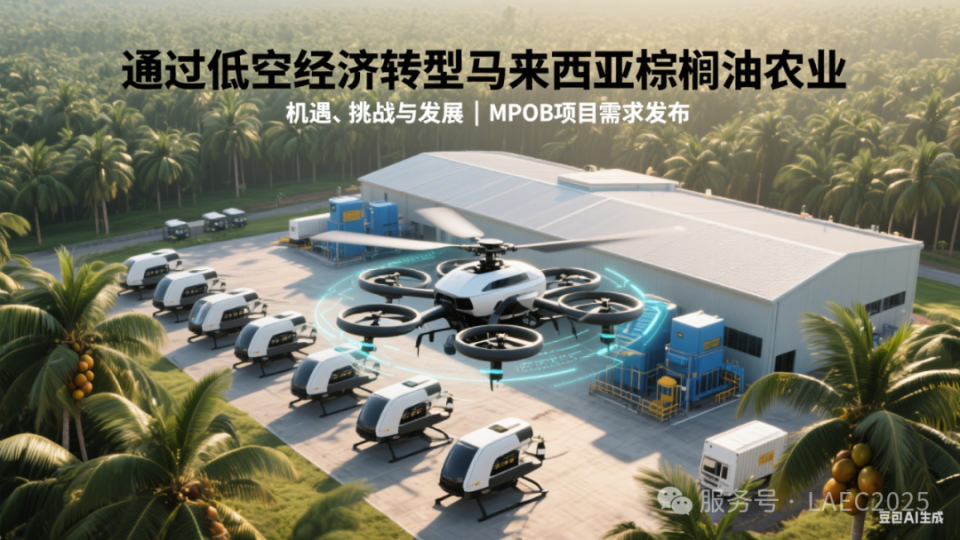
As Malaysia's central government agency overseeing the palm oil sector, MPOB is responsible for industry R&D, standardisation, and market promotion. The released requirements directly address practical pain points within Malaysia's palm oil industry, providing a clear implementation pathway for Sino-Malaysian low-altitude technology cooperation.
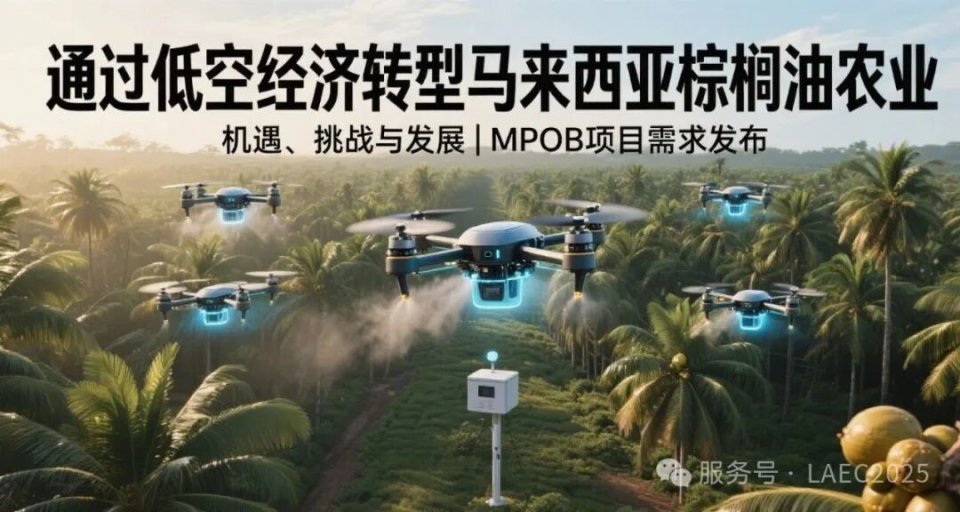
The requirements focus on operational challenges across the entire palm oil plantation value chain, primarily covering three key areas:
Firstly, precision pest and disease monitoring requires drones to replace manual inspections, enabling early detection of palm rust and dieback disease to enhance monitoring coverage and response speed;
Secondly, yield assessment and management necessitate establishing a ‘low-altitude data acquisition + AI analysis’ system. This utilises drone-derived data to estimate palm fruit yields, thereby optimising irrigation and fertilisation strategies.
Thirdly, post-harvest short-haul logistics require exploring a collaborative model combining ‘low-altitude cargo drones + ground autonomous vehicles’. This addresses transport losses incurred during the transfer of fresh fruit from harvesting points to processing facilities. This call for proposals not only clarifies technical application standards and collaboration objectives but also emphasises the principle of ‘technology introduction + localised adaptation’. It anticipates Chinese enterprises providing implementable, customised solutions tailored to Malaysia's palm plantation conditions (tropical rainforest climate, complex terrain) and cultivation practices, thereby creating a ‘scenario-based entry point’ for Chinese low-altitude technology firms to penetrate Southeast Asia's agricultural market.
2. Commercial Collaboration and Infrastructure: Overcoming Low-Altitude Application Challenges in Complex Scenarios
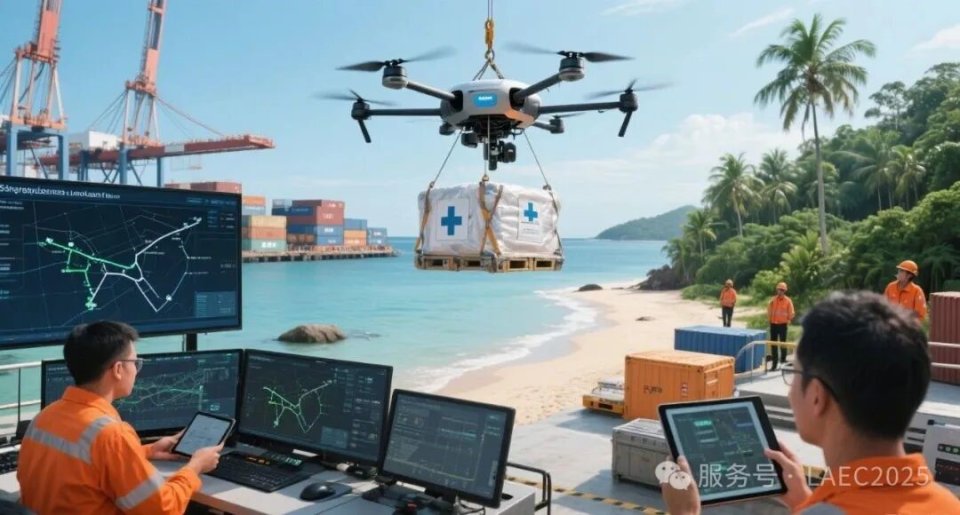
Addressing low-altitude service demands in unique geographical settings, Circular Investment has partnered with local enterprises to launch the **‘Low-Altitude + Logistics’ Transnational Cooperation Project**. This initiative focuses on extreme geographical conditions such as islands and mountainous regions, seeking collaboration with Chinese drone R&D and flight route scheduling enterprises: - Developing short-haul cargo drones with payloads of 50-100 kilogrammes for islands surrounding Southeast Asian nations, addressing inefficient and costly island supply chains; In Southeast Asian mountainous regions, establishing multi-node low-altitude logistics dispatch systems to enable rapid transit of agricultural produce and medical supplies. The project has secured preliminary cooperation agreements with multiple Shenzhen-based drone enterprises, with pilot operations slated for Q1 2026 to establish a ‘benchmark case’ for commercialising low-altitude logistics.
3. Talent Development and Certification: Establishing an International Talent Mobility Fast Track
The global advancement of low-altitude economy hinges on cross-border collaboration among specialised professionals. This coordination meeting unveils three major international talent initiatives to cultivate globally-minded core industry personnel:
· Sino-Thai Joint Pilot Training Programme: The Thai Civil Aviation Authority, in collaboration with ICCAIA (International Coordinating Council for Aerospace Industries Associations), plans to partner with Chinese universities and general aviation training institutions. This innovative model combines theoretical instruction in China with practical training and certification in Thailand. Trainees will complete foundational courses in flight principles and air traffic control regulations domestically before travelling to Thailand for hands-on aircraft training and obtaining internationally recognised pilot licences. This initiative addresses Southeast Asia's pilot shortage while advancing China's general aviation training standards globally.
· Singapore University of Social Sciences International Talent Exchange Programme: Singapore University of Social Sciences (SUSS) will formally establish a Low-Altitude Economy Research Centre while launching an international talent exchange initiative. The initiative encompasses three pillars: joint curriculum development (including specialised courses such as ‘Low-Altitude Economy Policy and Regulations’ and ‘Transnational Logistics Operations’), faculty-student research and practical training exchanges (annually dispatching 50 faculty and students to Chinese enterprises and universities), and vocational skills certification (jointly issuing industry qualifications with the Low-Altitude Economy Branch of the China Information Industry Association). It is projected to facilitate 200 cross-border talent exchanges in its inaugural year.
· Central Asian University-Enterprise Joint Training Programme: The International Professional Competency Certification Association (IPCCA) has partnered with universities in Tajikistan and other Central Asian nations to launch a joint talent development scheme for the low-altitude economy sector. The programme focuses on three core areas: drone operation, low-altitude traffic management, and emergency rescue technology. Chinese enterprises provide teaching materials and faculty support, while Central Asian universities deliver localised instruction in regional languages. Graduates receive IPCCA international certification, thereby building a talent pool for the low-altitude economy in Central Asia and providing human resources support for Chinese enterprises expanding into the region.
4. Multi-Party Cooperation Signing Ceremony: Witnessing Collaborative Outcomes Take Shape
As the culminating segment of the matchmaking event, the signing ceremony (16:45–16:55) will witness the formal execution of multiple cross-border memoranda of understanding and strategic agreements. Covering critical domains such as avionics system R&D and technology transfer, this marks the transition of preliminary demand alignment and exploratory research into substantive implementation. Stay tuned.
Summary: Project Implementation Injects Tangible Momentum into the Global Low-Altitude Economy
From establishing technological foundations through industry-academia-research collaboration, to clarifying industrial direction via demand releases from Malaysia's Palm Oil Board, then leveraging talent reserves as core capabilities to overcome application challenges through commercial partnerships – culminating in witnessing outcomes materialise during the signing session. This edition of the ‘International Low-Altitude Economy Demand Matching and Industrial Alliance Conference’ has forged a comprehensive, closed-loop collaborative ecosystem spanning the entire chain: technology-demand-talent-commerce. Centred on pragmatic collaboration, it charted concrete pathways for Chinese low-altitude enterprises to access Southeast Asian, Central Asian, and Middle Eastern markets.
Notably, the Malaysian Palm Oil Board's (MPOB) dedicated release of low-altitude application requirements for palm plantations not only provides a ‘scenario-based template’ for integrating agriculture with the low-altitude economy but also achieves full-chain alignment from ‘technology R&D – industrial demand – commercial implementation’. This propels cross-border cooperation from ‘concept exploration’ to ‘practical implementation’. As more such projects advance, Wuhu will progressively emerge as a pivotal hub for international low-altitude economic cooperation. This will foster resource sharing and complementary strengths between China and other nations in the low-altitude sector, jointly building a more open, efficient, and collaborative global low-altitude economic ecosystem.